
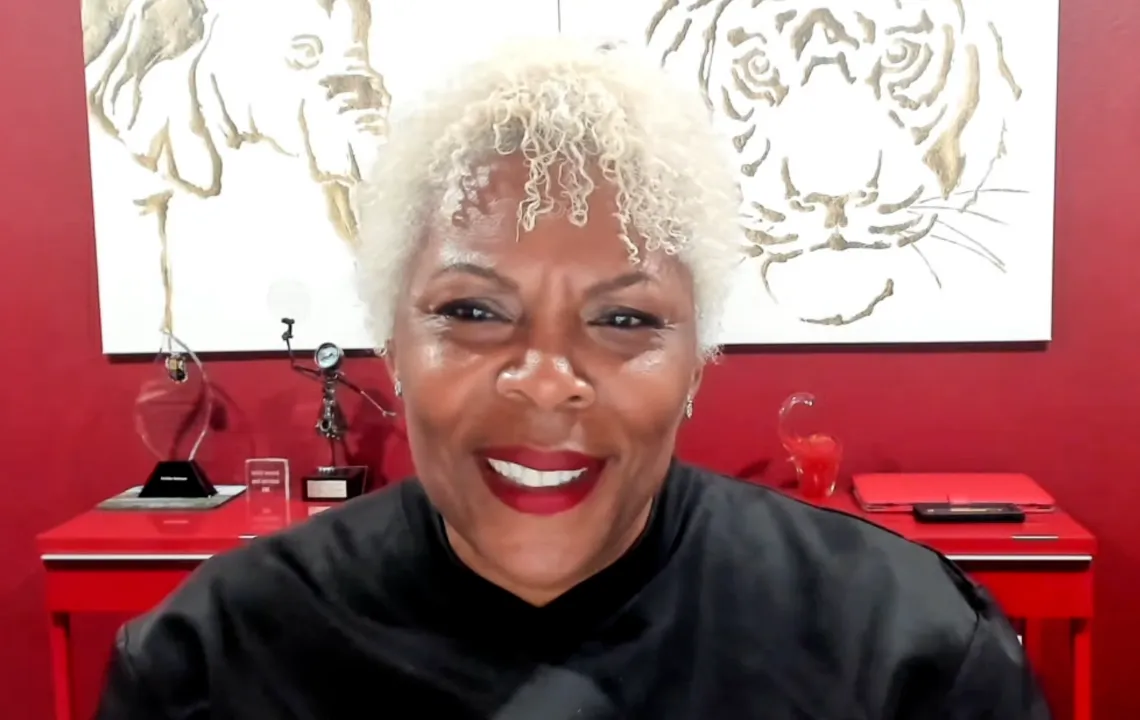
Carlisha Robinson: A dynamic Grambling grad redefining what’s possible for Black women in tech
Carlisha Robinson didn’t just survive corporate America; she mastered it. A Grambling State University graduate and tech executive with more than three decades of experience, Robinson spent years building products inside major companies before making a move that still makes people pause.
She left the C-suite behind and launched CBR Ventures, a firm designed to help founders build smarter, scale faster, and stop guessing their way through product development.
Watch the Full Episode
Carlisha Robinson left the C-suite to build something bigger than a job title
Robinson said entrepreneurship wasn’t a random pivot for her. It was mapped out long before she ever made the move. “I’m a planner. I’m a product manager,” she explained, adding that she approaches career growth the same way she approaches product development. “So, I constantly have a roadmap, and I also had a roadmap for my career.”
After reaching the level she had set for herself, the next move wasn’t another corporate climb. It was ownership.
What CBR Ventures actually does for startup founders trying to scale
CBR Ventures isn’t just positioned as a consulting firm. Robinson intentionally built it to be flexible enough to evolve into more than one lane. She said she chose the name “Ventures” because she wanted autonomy, “for it to be many things,” including mentoring, media work, and long-term expansion beyond traditional consulting.
But the purpose remains direct: bring elite product strategy to founders who don’t have corporate budgets.
Robinson said she’s seen too many brilliant entrepreneurs get stuck, not because they lack creativity, but because they lack access. And that’s where she steps in—helping founders, particularly women-owned and minority-owned companies, do what corporate teams can do with full support systems.
The biggest problem founders have is not tech, it’s focus and pace
Robinson has worked with enough companies to recognize a pattern. The struggle isn’t always the product itself.
It’s discipline.
“The two things I really work on are focus and pace,” she said, noting that startup environments are built for distraction. Founders can easily fall into the trap of building nonstop and assuming customers will magically show up. “We all know that’s not really a recipe for success,” she said.
She also made it clear that investor funding doesn’t guarantee success. “The business doesn’t grow off of the idea alone,” Robinson said. What matters is whether the company can deliver value and generate revenue beyond investor checks.
When startups usually hire her as a fractional CPO
Robinson said she typically comes into companies during critical growth phases, especially when a startup is moving beyond the early idea stage and entering serious scaling territory.
She often starts working with businesses during Series B or Series C fundraising rounds, when the company is trying to accelerate and “hockey stick up,” as she described it. That phase demands more than ambition—it takes marketing, research, customer targeting, and a clear execution plan.
Her typical clients, she said, are often in the $10 million to $50 million range, where the company’s future depends on predictable customer revenue rather than continued investment.
Why she started her business: “I’ve made a lot of already rich people even richer.”
Robinson didn’t soften her reasons for leaving corporate life.
She said the move was fueled partly by burnout, but more importantly by purpose. “I’ve made a lot of already rich people even richer,” Robinson said, explaining that she reached a point where she wanted her expertise to benefit communities that are routinely denied access.
For Robinson, her work is connected to service—not as a slogan, but as a lived commitment. As a member of Delta Sigma Theta Sorority, Inc., she described that “give back” mindset as foundational. The mission, she said, is to support people who are brilliant but overlooked. She wants to “see them develop and thrive and grow their businesses into successful businesses and get a piece of the pie.”
What DEI changes mean for Black professionals and why the knowledge still matters
When the conversation turned to the shifting DEI landscape, Robinson didn’t pretend the moment wasn’t serious.
But she also made one thing clear: what’s being dismantled politically and publicly can’t erase what she knows.
“While we can take away DEI as an acronym,” she said, “what you can’t take away is the knowledge and the information that I have and the experience that I have.”
She noted that the biggest impact right now isn’t always about personal opportunity; it’s about budget decisions. Companies are tightening spending across the board, and that affects consulting, hiring, and contract work. In her words, “people have to really be able to see the value… before they will pull the trigger.”

Black women in tech still face underpay, undervaluation, and “the angry Black woman” label
Robinson said she realized early in her career that the rules were different for Black women in tech, because in most rooms, she was the only one.
“I’ve always been very much the only one,” she said, “maybe two if we’re lucky.”
She described classic patterns that remain familiar to many Black professionals: being underpaid, overlooked for promotions, underestimated, and undervalued. The most telling part wasn’t that these things happened—it’s that she had to fight repeatedly to correct them.
“I’ve had to fight every single time to make sure that I am getting what I am due,” she said. And even when people try to weaponize stereotypes, she refuses to shrink. “Whether someone wants to label me as an angry Black woman or not… pay me what you owe me.”
How Grambling State prepared her to compete in rooms that weren’t built for her
The conversation hit home when Robinson discussed what Grambling gave her, not just academically, but psychologically.
Robinson said she entered internships surrounded by students from major PWI programs, expecting them to be ahead. But the reality flipped fast. “I was overprepared,” she said, because Grambling trained her beyond coursework.
She credited mentors at Grambling for instilling professionalism early, and she recalled learning quickly that she didn’t need to fear corporate rooms. “I realized in that moment that I don’t have to fear being in the room,” Robinson said, “because I should be in the room.”
That’s not just confidence. That’s conditioning.
Why Robinson says AI “strategy” is a myth and entrepreneurs need a real technology plan
Robinson didn’t lean into trendy language when discussing artificial intelligence. She dismissed the phrase that many founders are using right now.
When clients ask her to help develop an “AI strategy,” she responds plainly: “There’s no such thing. It’s your technology strategy, and it may or may not have AI in it.”
She explained that AI isn’t new; it’s simply the latest major wave of innovation. The difference is its speed. She compared it to the internet, noting how quickly AI adoption happened because infrastructure was already in place.
And when she described how far AI has already spread, she didn’t use tech jargon. She used imagery. “AI is as pervasive as water,” Robinson said, “because it has seeped into everything.”
The scariest part of entrepreneurship is walking away from certainty
I asked Robinson directly what it felt like to leave behind corporate security and start fresh.
She didn’t pretend she was fearless.
“Terrified,” she said, explaining that it’s not easy to cut off a major income stream and start from scratch. Later in the interview, she confirmed she was walking away from roughly $450,000+ in salary.
But she also gave the most grounded answer possible when doubt shows up. “If it doesn’t work,” she said, “then you’re talented, you’re smart, you can figure it out. You have options.”
Entrepreneurship is risk, but it’s also resilience.
She wants Black entrepreneurs to build wealth when corporate doors close
Robinson said one of her goals is for CBR Ventures to become a real example of what’s possible when Black professionals stop waiting for permission.
In her view, entrepreneurship isn’t just a career choice right now; it’s survival.
“Sometimes when corporate America is purposefully trying to push you out,” she said, “hang your own flag and go and build your own.”
She tied that directly to wealth, legacy, and closing the gap. The generational wealth divide, she said, is still enormous. But entrepreneurship remains one of the most powerful tools for changing the future.
Connect with Carlisha and CBR Ventures
Website: https://www.cbrventures.com/
Instagram: @carlisharobinson
LinkedIn: https://www.linkedin.com/in/carlisharobinson/
Subscribe to the Kenn Rashad Channel
Subscribe to the HBCU Titans podcast on the Kenn Rashad YouTube Channel.